
About us
History | Governance | Partners| Network Supporters | Funding | Why sign | Our people
The United Nations-backed Principles for Responsible Investment Initiative (PRI) is a network of international investors working together to put the six Principles for Responsible Investment into practice.
The Principles were devised by the investment community. They reflect the view that environmental, social and corporate governance (ESG) issues can affect the performance of investment portfolios and therefore must be given appropriate consideration by investors if they are to fulfil their fiduciary (or equivalent) duty. The Principles provide a voluntary framework by which all investors can incorporate ESG issues into their decision-making and ownership practices and so better align their objectives with those of society at large.
The PRI Initiative was created after the launch of the Principles to help investors to implement the Principles. The Initiative is managed by the PRI Secretariat and supports investors by sharing best practice, facilitating collaboration and managing a variety of work streams. The Initiative is incorporated as a not-for-profit company limited by guarantee.
The Initiative is funded by an annual subscription fee introduced for all signatories. This fee is on a sliding scale according to the relative size of the investor and their signatory type.
History
In 2005 the United Nations Secretary-General invited a group of the world's largest institutional investors to join a process in developing the Principles for Responsible Investment. Individuals representing 20 institutional investors from 12 countries agreed to participate in the Investor Group. The Group accepted ownership of the Principles and had the freedom to develop them as they saw fit.
The Group was supported by a 70-person multi-stakeholder group of experts from the investment industry, intergovernmental and governmental organisations, civil society and academia. The process, conducted between April 2005 and January 2006 involved deliberations in a series of all-day long discussions and debate. The Principles for Responsible Investment emerged as a result of these meetings.
The process was coordinated by the United Nations Environment Programme Finance Initiative and the UN Global Compact.
Following the launch of the Principles, the PRI Secretariat was created to help co-ordinate the adoption of the Principles by additional investors, provide comprehensive resources to assist investors in implementing the Principles, and to facilitate collaboration among signatories.
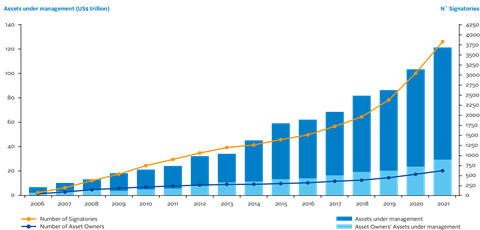
As of April 2012 over 1000 investment institutions have become signatories, with assets under management approximately US$ 30 trillion. A full list of current signatories can be found at www.unpri.org/signatories.
Governance
The PRI's financial and legal affairs had until 2010 been run from the Foundation for the Global Compact, based in New York. As a result of PRI's growth and increased operational activity in the UK, PRI Association was established in the UK to house the initiative. PRI Association is a company limited by guarantee (a not-for-profit) with its directors appointed by PRIAC.
In 2011, four non-asset owner signatories were elected to the PRI Advisory Council.
PRI Advisory Council members
Wolfgang Engshuber (chair), President, Corporate Centers, Munich Re America
Wolfgang Engshuber was elected chair of PRIAC as well as PRIA in January 2011. He is an ex officio Board member of the UN Global Compact.
After a career spanning 25 years, he retired formally from his executive position at Munich Re in October 2011, although he will continue as a senior advisor. As President, Corporate Centres, Munich Re America for 13 years, he oversaw key corporate departments, including Investments, Integrated Risk Management, Human Resources, IT, Claims, Legal, Internal Audit and Marketing. Dr. Engshuber served as a director of MEAG New York, a company that manages North American assets of Munich Re.
Before moving to the United States in October 1998, he was employed by Munich Re where he was a member of the executive management responsible for global asset management.
Dr. Engshuber earned his Masters of Law Degree in 1982 and a Ph.D. in Economics in 1986, both from the University of Munich. He also studied at the London School of Economics and worked for the International Monetary Fund and the German Ministry for Developing Countries.
High resolution photograph for conference publications and websites.
Achim Steiner, Executive Director, UNEP (Paul Clements-Hunt as special designate)
Achim was unanimously elected as UN Environment Programme Executive Director in 2006, becoming its fifth Executive Director in its history. Before joining UNEP, Achim served as Director General of the World Conservation Union (IUCN), widely regarded as one of the most influential and highly respected organisations in the field of conservation, environment and natural resources management. Achim has a professional record in the fields of sustainable development policy and environmental management, first-hand knowledge of civil society, governmental and international organizations. He serves on a number of international advisory boards, including the China Council for International Cooperation on Environment and Development. Achim has degrees from University of Oxford and University of London. He also studied at the German Development Institute and Harvard Business School.
Georg Kell, Executive Director, UN Global Compact (Gavin Power as special designate)
Georg Kell is the Executive Director of the UN Global Compact. Following extensive experiences in Africa and Asia as a financial analyst, Kell began his career at the UN in Geneva, where he worked from 1987 to 1990 with the UN Conference on Trade and Development (UNCTAD). In 1990, he joined the New York office of UNCTAD, which he headed from 1993 to 1997. In 1997, Kell became a senior officer in the Executive Office of UN Secretary-General Kofi Annan, responsible for fostering cooperation with the private sector. He has served as head of the UN Global Compact since 2000. A native of Germany, Kell holds advanced degrees in economics and engineering from the Technical University of Berlin.
David Atkin, CEO, CBUS
David is Chief Executive Officer of CBUS, the Australian superannuation scheme with in excess of 670,000 members. Prior to joining CBUS in January 2008, David was the CEO for Emergency Services and State Super (ESSSuper). David has also been the CEO for JUST Super as well as the National Marketing and Communications Manager for STA.
Before moving into superannuation, David had an industrial relations background including positions at the FSU and CPSU.
David joined the Board of Association of Superannuation funds of Australia (ASFA) in February 2010 and is also a member of the CEO panel for the Investor Group on Climate Change (IGCC). David is also a Board Director for Frontier Investment Consulting.
David has a BA Hons University of Melbourne, Master of Arts Latrobe University and a Diploma of Financial Services and was recently recognised with distinguished alumina award from La Trobe University for his work in the sustainable finance field.
Else F. Bos, Deputy Chairman Executive Committee and Chief Institutional Business, PFZW representative
Ms Bos started at PGGM Investments in 2003 as Director of Third Parties, Operations & Staff. In March 2005 she was appointed Chief Executive Officer for investments and became a member of the Board of Directors of PGGM. In 2001 she joined NIBC Asset Management as Co-Head Investments and was responsible for people, process and project management within the Investment Management Department. In 2002 she became COO/CFO at NIBC Asset Management and was responsible for Operations, IT, Finance, Risk Control, HR, Legal and Office Management. Else graduating in 1983 from Rotterdam Erasmus University, where she studied Econometrics.
Howard Jacobs, Trustee, Universities Superannuation Scheme
Howard is Director, Chairman of the Remuneration Committee and member of the Investment Committee at Universities Superannuation Scheme, the principal pension scheme for UK academics. Howard became a Partner with law firm Slaughter and May in 1986, specialising in employment, pensions and equity incentive advice. Between 2001 and 2004, Howard was a representative of the Association of Pension Lawyers on the joint working group with the UK Inland Revenue, producing two consultation documents about the simplification of pension taxation; proposals now enacted in the Finance Act 2004. Howard is also Vice President of I CAN, an education charity for children with speech and language difficulties.
Sopawadee Lertmanaschai, Secretary-General, Government Pension Fund of Thailand (GPF)
Sopawadee Lermanaschai supervises a team of approximately 300 staffs managing the fund worth more than 500,000 Million Baht (US$ 16.7 billion) for 1.2 million members. Prior to joining GPF, Sopawadee has gained extensive experiences working with the Stock Exchange of Thailand (SET) since 1977, only 2 years after its inception. During her 33-year tenure at SET, Sopawadee was assigned to be in charge of major stock exchange functions both in support and front positions. Her key roles were, to name but a few, managing and supervising Thailand Futures Exchange, Market for Alternative Investment, Thai Trust Fund, Thailand Clearing House, Thailand Securities Depository, and Market and Post-Trade Services. Graduated in both Law and Accounting from Thammasart University, Sopawadee further strengthened her expertise in Wharton with the Advanced Management Program. As her special interest is developing investment returns while taking into account the role of social responsibility, she is also senior advisory board members of many non-profit organizations.
Priya Sara Mathur, board member, CalPERS
Priya Sara Mathur is serving her second term on the Board of Administration representing public agency members of CalPERS. She is Chair of the Health Benefits Committee and Vice Chair of the Risk Management Committee. She also serves on the Benefits and Program Administration, Investment, Finance, and Board Governance committees and the Policy Subcommittee of the Investment Committee.
Ms. Mathur is a principal financial analyst for Bay Area Rapid Transit District. In that capacity, she finances multi-billion dollar infrastructure projects, including BART's US$ 1.5 billion earthquake retrofit program. Ms. Mathur has a Master's degree in Business Administration from the Haas School of Business, University of California, Berkeley, and a Bachelor's degree in economics and literature from Connecticut College.
John Oliphant, Head of Investments and Actuarial, Government Employees Pension Fund of South Africa
John is currently the Head of Investments and Actuarial of the Government Employees Pension Fund – the largest Pension Fund in Africa, and is the main driver behind the investment strategies of the fund. John has been the key driver behind GEPF's responsible investment policies and the setting up of the PRI South African Network. John is also member of the following committees and councils: Investment Committee of the GEPF, Investment Committee of the Pan African Infrastructure Development Fund ("PAIDF"), Advisory Council of the Southern Africa Pension Fund Investment Forum ("SAPFIF") and Johannesburg Stock Exchange SRI Index Advisory Committee.
John holds a BSc (Actuarial Science) and a BSc(Hons) Advance Mathematics of finance both from the University of the Witwatersrand, Johannesburg. He was previously the Head of Quant Investing at STANLIB, were he managed long only funds as well as hedge funds.
Niels Erik Petersen, CIO, Unipension
Since 2008 Niels has been CIO at Unipension, which has EUR 10 billion under management. Prior to his current position he among others worked as Head of Equities at ATP for 5 years and as Head of Equities at Danske Bank for more than 10 years. He has also held senior positions in corporate finance at Danske Bank and Enskilda for a number of years.Niels has previously been board member and chairman of The Danish Society for Financial Analyst for 10 years.
Renê Sanda, CIO, PREVI
Rene Sanda has been the PREVI Chief Investment Officer since June 2010. In 2005 he was named PRM Candidate of the Year by the Professional Risk Management Association. Prior to becoming PREVI CIO, he was the Risk Management Director of the Banco do Brasil, where he was responsible for the overall risk management
of the Bank. He also served as a board member of the Banco do Brasil´s
broker dealers located in London and New York.
Sanda holds a masters degree in statistics from the Universidade de Sao Paulo and an executive MBA in finance from Instituto Brasileiro de Mercado de Capitais.
Daniel Simard, General Coordinator, Comité syndical national de retraite Bâtirente
Daniel Simard has been a Board member of Bâtirente since its launch in 1987, when he became its managing director in 2000. Bâtirente's assets reach over US$ 750 million, serving 25,000 individual unionised workers.
Daniel has twenty years' experience in the areas of collective bargaining, pension benefits and labour court representation. A Université de Montréal graduate in Industrial Relations, he is a registered Representative with Québec's Financial Market Authority. Daniel is involved in pension fund administration and chairs the audit committee of a large public corporation's pension fund. He sits on the Board of the Mouvement pour l'éducation et la défense des actionnaires, a local association promoting minority shareholder interests in Canada.
Paul Abberley, CEO, Aviva Investors London
In this dual role Paul is both responsible for all Aviva Investors' high alpha business in
the UK, and for developing and delivering Aviva Investors' fixed income investment
philosophy in the UK.
Paul joined the investment industry in 1981 and Aviva Investors in September 2008.
He was previously at ABN Amro Asset Management for 8 years where he worked in a
series of fixed income roles and as CEO for London. Paul has also worked as a global
head of fixed income at Lombard Odier.
Paul holds an MA in Philosophy, Politics and Economics from Keble College, Oxford.
Melissa Brown, board member, Responsible Research
A leading Asian RI analyst, Melissa currently focuses on emerging market investments
as a Partner of Serasi Capital, a Singapore-based private equity fund of funds. Resident in Asia since 1988, she analysed Asian investments for 20+ years as a sell-side equity
analyst and research director for Barclays Capital, JPMorgan, and Citigroup in Seoul
and Hong Kong.
During Melissa's tenure as the Executive Director of ASrIA (2003-2008), she was
responsible for a range of innovative ESG research initiatives. In addition to serving on
the board of Responsible Research, she is a member of the HKEX Listing Committee.
Ann Byrne, CEO, Australian Council of Superannuation Investors
Ann Byrne joined ACSI as Chief Executive Officer in early 2008 following a background
as CEO of two major superannuation funds. UniSuper - the superannuation fund for
staff of Australia's 37 universities and the Superannuation Trust of Australia (now
Australian Super) - a multi industry fund created for the manufacturing sector.
In 2007, Ann was awarded the Fund Executive of the Year and was a member of the
board of the Association of Superannuation Funds of Australia (ASFA).
Ann is a board member of Oxfam (Australia), a member of the Monash University
Department of Accounting, Finance Advisory Committee and a member of the ICGN
Shareholder Rights Committee and a member of the Network for Sustainable Financial
Markets (NSFM).
She is a Fellow of the Australian Institute of Company Directors and the Australian Institute of Superannuation Trustees (AIST).
Luciane Ribeiro, CEO, Santander Brasil Asset Management
Luciane Ribeiro graduated in Economics and has a 28-year experience in the financial
sector. She started at Bank Boston in 1983, moving to Banco Safra in 1985. After 17
years as wealth manager of shareholder's assets, in 2002 she became responsible for
the Asset Management unit. In 2006, Luciane was invited to be CEO for Latin America
of ABN-AMRO Asset Management, and became CEO of Santander Brasil Asset
Management after the merger in 2008, leading the integration of the two business
units. She is also Anbima's Director, Brazilian investment self-regulatory agency, and member of Santander Brasil Asset Management's SRI Board.
Partners
The Principles for Responsible Investment has two UN partners:
United Nations Environment Programme Finance Initiative (UNEP FI)
UNEP FI is a unique public-private partnership between UNEP and the global financial sector. UNEP works with over 170 banks, insurers and investment firms, and a range of partner organisations, to develop and promote linkages between sustainability and financial performance. Through its comprehensive work programme encompassing research, training, events and regional activities, UNEP FI carries out its mission to identify, promote and realise the adoption of best environmental and sustainability practice at all levels of financial institution operations.
www.unepfi.org
United Nations Global Compact
Launched in 2000, the UN Global Compact brings business together with UN agencies, labour, civil society and governments to advance ten universal principles in the areas of human rights, labour, environment and anti-corruption. Through the power of collective action, the Global Compact seeks to mainstream these ten principles in business activities around the world and to catalyze actions in support of broader UN goals. With more than 5300 participating businesses from over 135 countries, it is the world's largest voluntary corporate sustainability initiative.
www.unglobalcompact.org
Network Supporters
PRI Network Supporters are non-profit, peer organisations that would like to publicly express support for the PRI within their constituencies. This partnership enables Network Supporters to work with the PRI to raise awareness of responsible investment and the PRI within the investment community in different regions and sectors. Membership is reviewed on an annual basis. More details on becoming a Network Supporter can be found here. A list of current Network Supporters can be found here.
Funding
The PRI relies on the financial and in-kind support of generous contributors from the network to ensure the successful delivery of our products and strategy.
- From 2011, an annual subscription fee is to be introduced for all signatories. This fee will be on a sliding scale according to the relative size of the investor and other criteria currently under consultation.
A small amount of other funding comes from institutional grants from governments, and international organisations. These are normally associated with specific projects and agreed objectives such as in the case of the Danish Government's contribution to the work of the PRI Academic Network. Corporate sponsorship and in kind support is also given for stand-alone events such as our annual PRI in Person event.
Why sign?
- Improve your understanding and management of complex issues, risks and value drivers related to responsible investing
- Gain access to a comprehensive knowledge bank of implementation support, reducing research and implementation costs, through our Enhanced Research Portal platform and PRI in Practice posts of best practice
- Be part of a global network of peer investors exploring and acting on ESG issues
- Reputational benefits from publicly demonstrating top-level commitment to integrating ESG issues in a way that is consistent with fiduciary duty
- Contribute to a more long-term oriented, transparent, sustainable and well-governed investment market and business activity
- Participate in shaping the global investment agenda by participating in the Initiative's various sectoral and regional groups
- Gain access to key stakeholders from the government and civil society
Become a signatory